

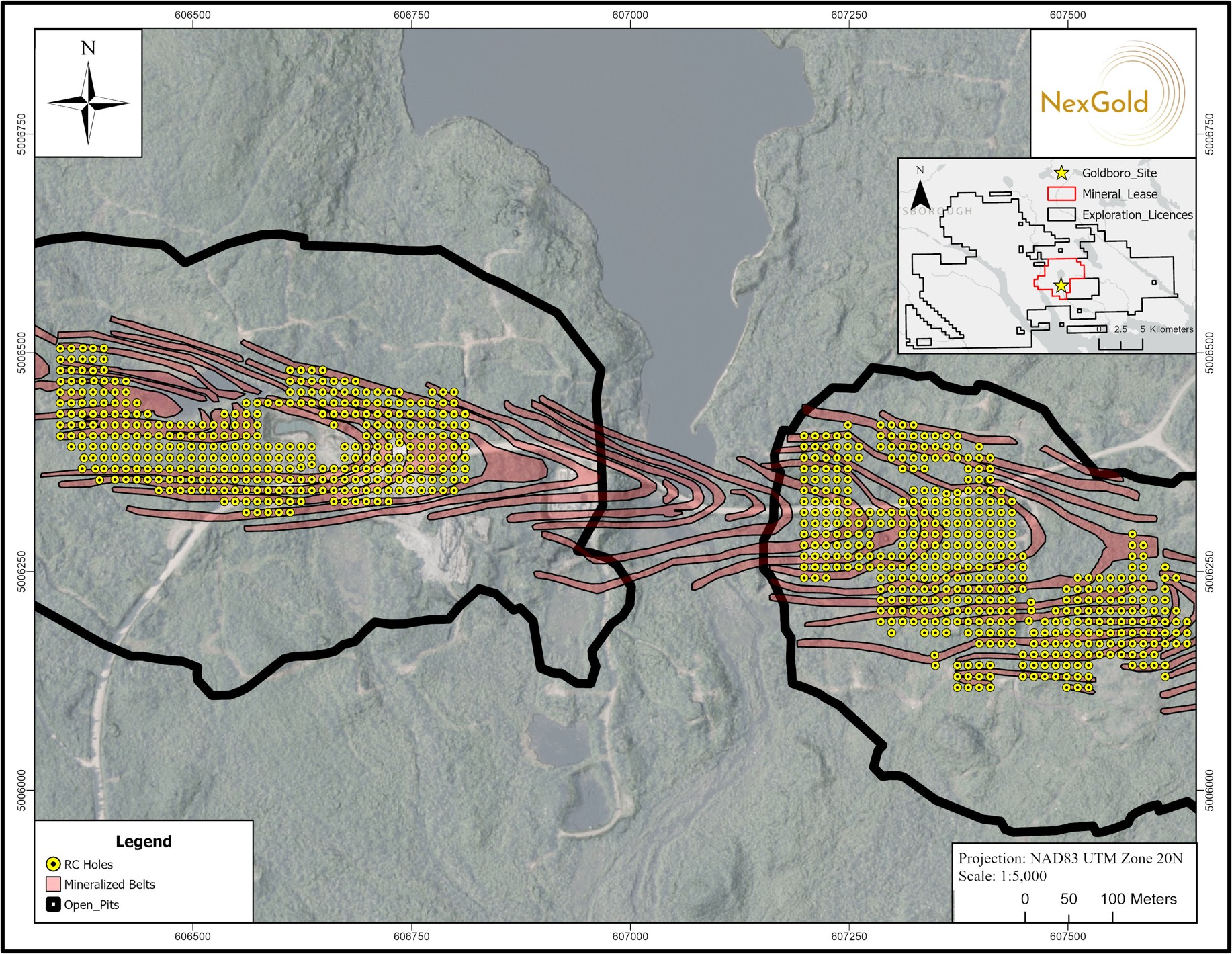
TORONTO, Aug. 19, 2026 (GLOBE NEWSWIRE) — NexGold Mining Corp. (TSXV: NEXG; OTCQX: NXGCF) (“NexGold” or the “Company”) is pleased to provide additional results from its 40,000-metre, detailed Reverse Circulation infill drill program (“RC Infill Drill Program”) at the Company’s Goldboro Gold Project in Nova Scotia (“Goldboro Project”). The RC Infill Drill Program is focused on the Goldboro Deposit and is designed to infill specific areas of the Goldboro Mineral Resource within the planned west and east pits at a nominal drill spacing of 12.5 metres and down to depths of 50 metres (Figures 1 and 2).
Kevin Bullock, President, CEO & Director of NexGold, commented: “The RC Infill Drill Program is progressing very well, with over 76% of the expanded drilling program complete. With our recently closed flow-through financing of $10M, we made the decision to increase the drilling program from 30,000 metres to 40,000 metres in order to further define Mineral Resources at shallow levels, consistent with the initial years of the mine plan within the west and east pits. We continue to see assay results that support the location, grade tenor and thickness of mineralization within the west pit at a level of detail not previously drilled at the Goldboro Project, including within the central area of the west pit that is scheduled for the initial years of mining.
“The Company continues to advance the Goldboro Project as we move toward a potential investment decision later this year. The objective of the current infill drill program is to further increase confidence in the Mineral Resources and Mineral Reserves supporting the Project, with a focus on areas of the Mineral Resource expected to be mined during the early years of production and within the anticipated payback period. These drill results are expected to support the evaluation of a final investment decision and may be incorporated into future Mineral Resource estimates beyond the updated Feasibility Study, which is expected to be completed later this year.
“We anticipate the RC Infill Drill Program will continue throughout Q3 2026 and look forward to providing updates as assay results become available, subject to drilling progress, laboratory turnaround times and other factors.”
The high-density RC Infill Drill Program targets areas of the Goldboro Project associated with the initial years of the current mine plan and that are presently accessible for drilling. The objective of the program, and the rationale for using Reverse Circulation (“RC”) drilling, is to obtain a high-density data set that may support future evaluation of the Mineral Resource for potential classification upgrades from the Indicated to Measured category, using a drilling technique that more closely approximates production drilling and associated dilution. The Company expects this information to be used in conjunction with more than 180,000 metres of existing diamond drill data to support planning and evaluation of the initial years of mining contemplated in the current mine plan.
Drill results in this news release represent 3,591 metres of drilling from 85 RC drill holes (RC-26-160 to 196, RC-26-199 to 205, RC-26-209 to 229 and RC26-254 to 258, 261, and RC-26-310 to 323) completed within the west pit area (Table 1). Based on QA/QC procedures and data, as well as comparisons with historical drilling and ongoing geological interpretation, the drill results are considered consistent with the Company’s current understanding of the mineralization. The drilling intersected mineralization consistent with the geological model for the Goldboro Deposit and provided additional definition of the mineralized zones at a higher drill density. Results show grade tenor and thickness as those intersected in diamond drill intersections in the same area, which were completed at wider spacing, as illustrated on vertical cross sections T-AD (Figure 3). A complete table of significant gold intersections is provided in Table 2 below. Selected highlights from the RC Infill Drill Program include:
- 5.26 g/t Au over 7.0 m (from 41.0 m to 48.0 m), including 31.29 g/t Au over 1.0 m (from 44.0 to 45.0 m) in drill hole RC-26-226;
- 7.08 g/t Au over 5.0 m (from 9.0 m to 14.0 m), including 25.11 g/t Au over 1.0 m in drill hole RC-26-195;
- 14.97 g/t Au over 2.0 m (from 38.0 m to 40.0 m), including 29.62 g/t Au over 1.0 m and 0.90 g/t Au over 11.0 m (from 25.0 m to 36.0 m) in drill hole RC-26-163;
- 5.42 g/t Au over 3.0 m (from 36.0 m to 39.0 m), including 15.69 g/t Au over 1.0 m, 5.10 g/t Au over 1.0 m (from 7.0 m to 8.0 m) and 1.09 g/t Au over 9.0 m (from 25.0 m to 34.0 m) in drill hole RC-26-168;
- 1.10 g/t Au over 10.0 m (from 7.0 m to 17.0 m) and 2.44 g/t Au over 4.0 m (from 33.0 m to 37.0 m) in drill hole RC-26-223;
- 18.54 g/t Au over 1.0 m (from 16.0 m to 17.0 m) in drill hole RC-26-176;
- 1.40 g/t Au over 7.0 m (from 32.0 m to 39.0 m) and 7.03 g/t Au over 1.0 m (from 6.0 m to 7.0 m) in drill hole RC-26-219; and
- 1.61 g/t Au over 7.0 m (from 16.0 m to 23.0 m) in drill hole RC-26-227.
Figure 1. Map showing the Goldboro Project location and the planned drill hole locations for the current RC Infill Drill Program relative to the initial years of mining contemplated in the 2021 Feasibility Study.
The Company expects to incorporate the results of the RC Infill Drill Program into a future updated Mineral Resource Estimate that is expected to be completed separately from the ongoing updated Feasibility Study. As the updated Feasibility Study is expected to be completed later in 2026, and the RC Infill Drill Program remains ongoing, results from the program will not be available for incorporation into the Mineral Resource Estimate supporting the updated Feasibility Study. The Company previously completed a technical report on the Goldboro Project prepared by Nordmin Engineering Ltd., entitled “NI 43-101 Technical Report and Feasibility Study for the Goldboro Gold Project, Eastern Goldfields District, Nova Scotia”, with an effective date of December 16, 2021 and a report date of January 11, 2022 (the “2021 Feasibility Study”). The technical report is available on SEDAR+ at www.sedarplus.ca and on the Company’s website at www.nexgold.com.
Figure 2. A map showing the location of drill holes reported in this news release and the associated cross sections relative to planned early-years of mining as reported in the 2021 Feasibility Study.
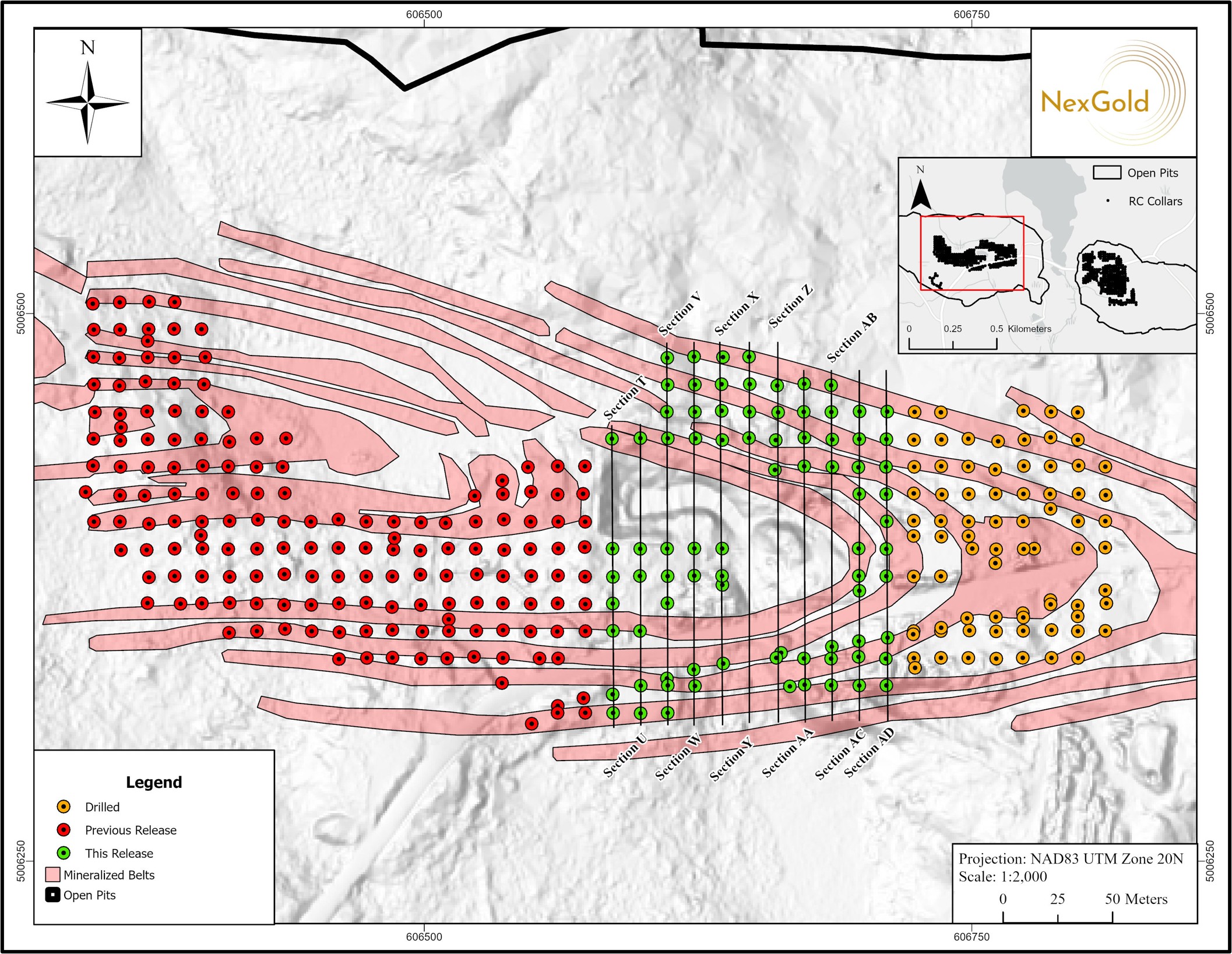
Figure 3. Vertical north-south cross sections (T-AD) looking east showing drill holes for the RC Infill Drill Program reported in this news release. The cross sections correspond to the section lines shown in Figure 2. Areas along the section lines without drill holes represent portions of the deposit that are not currently accessible to drilling due to historical workings or surface access constraints. These areas are expected to be drilled in the future when access becomes accessible.
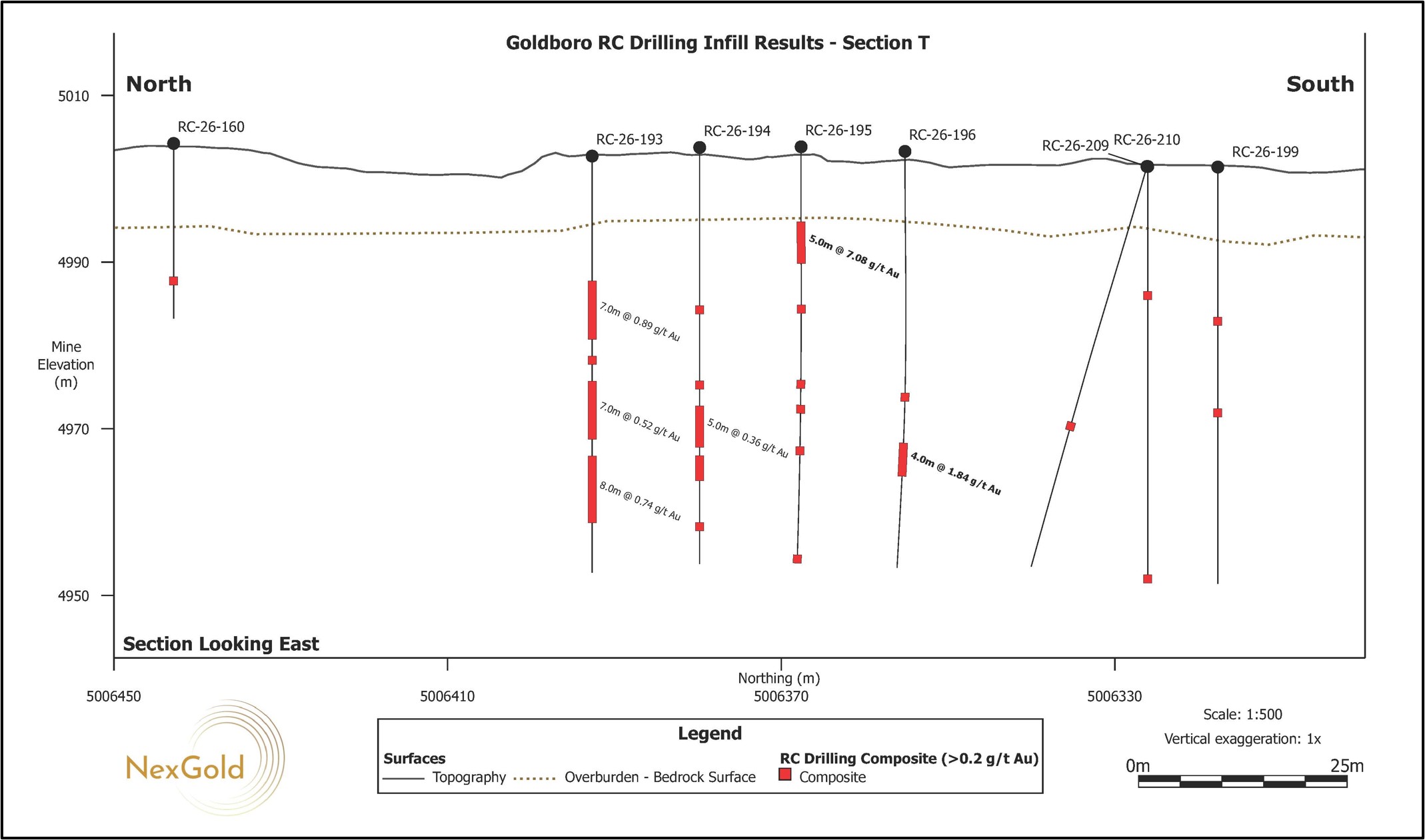
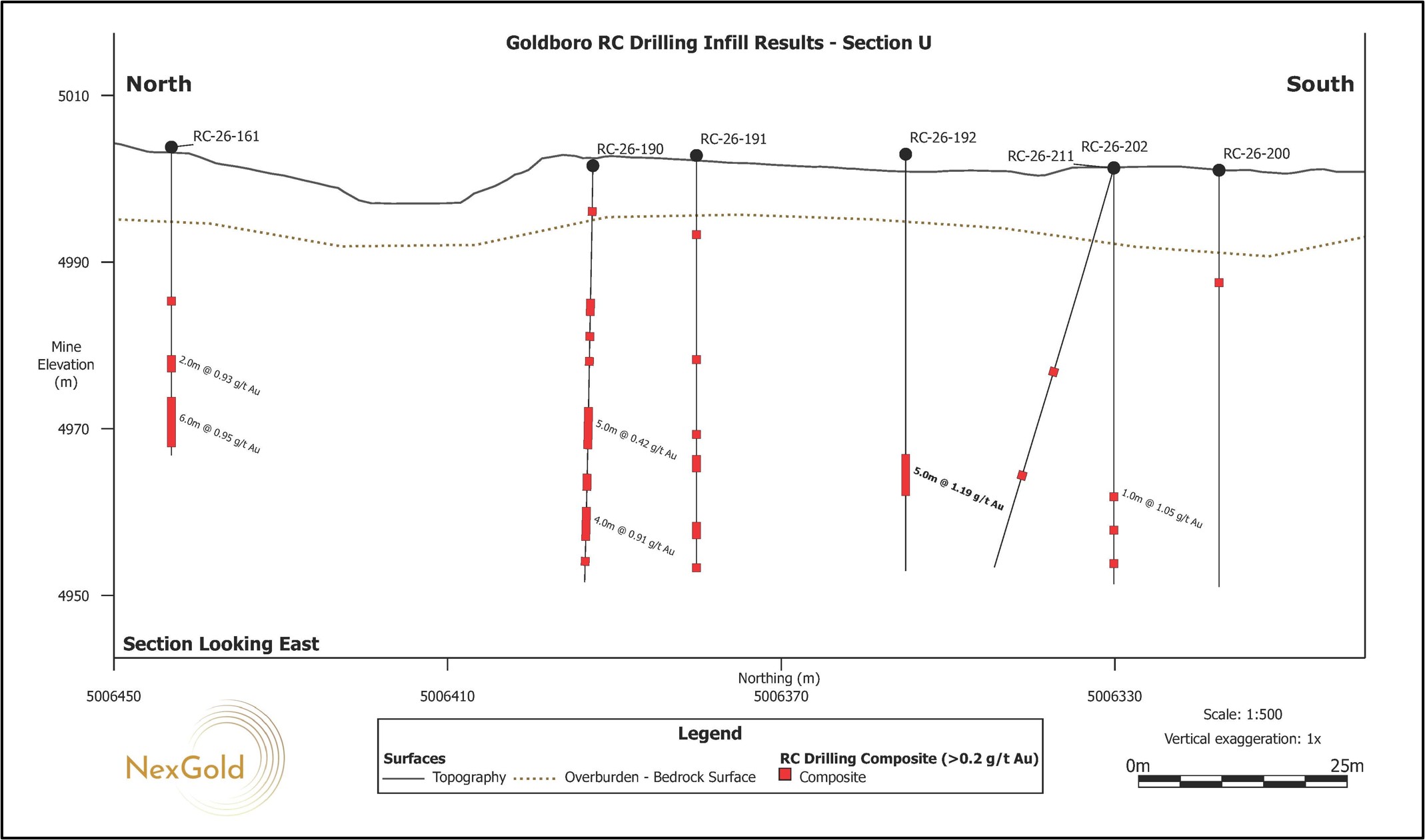
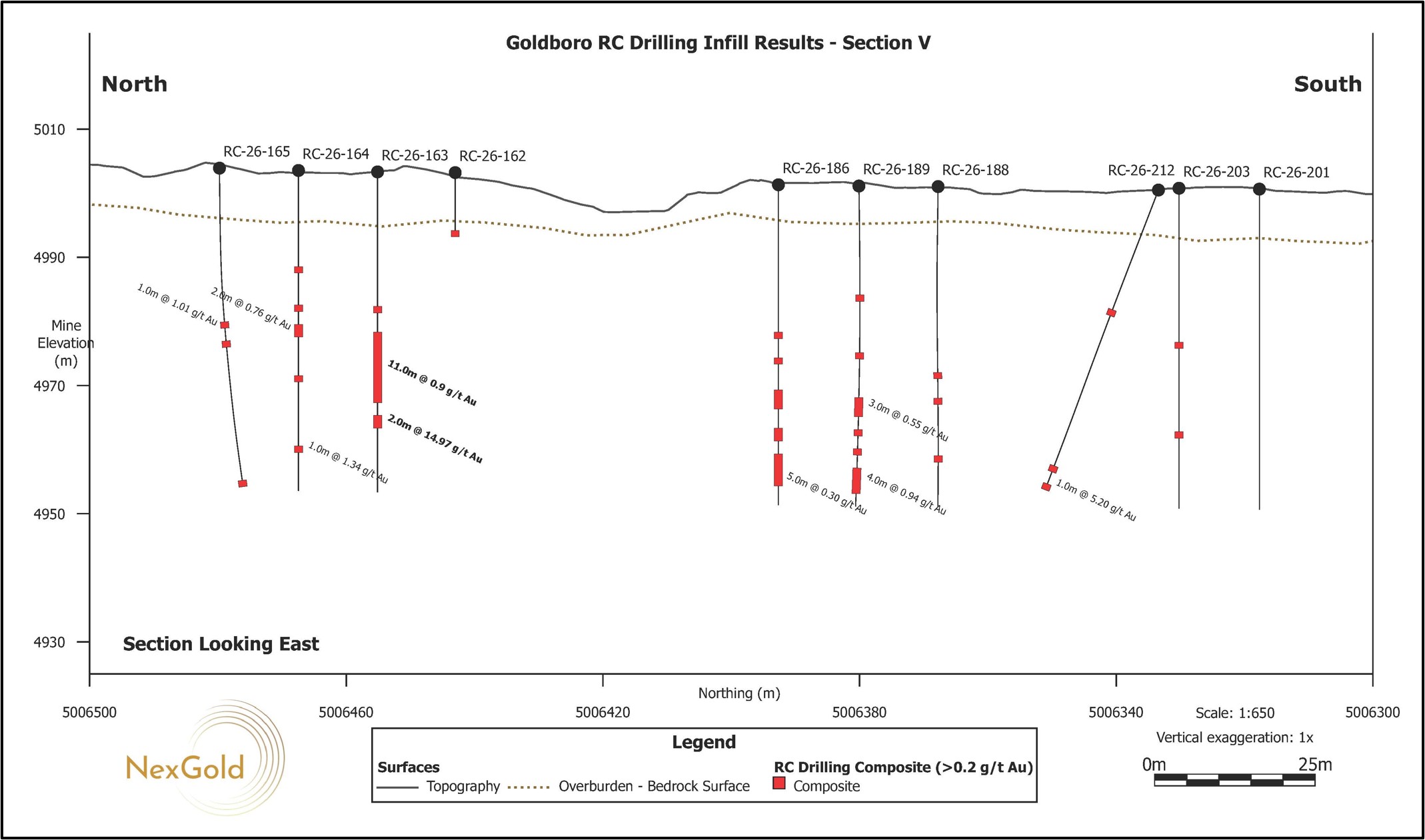
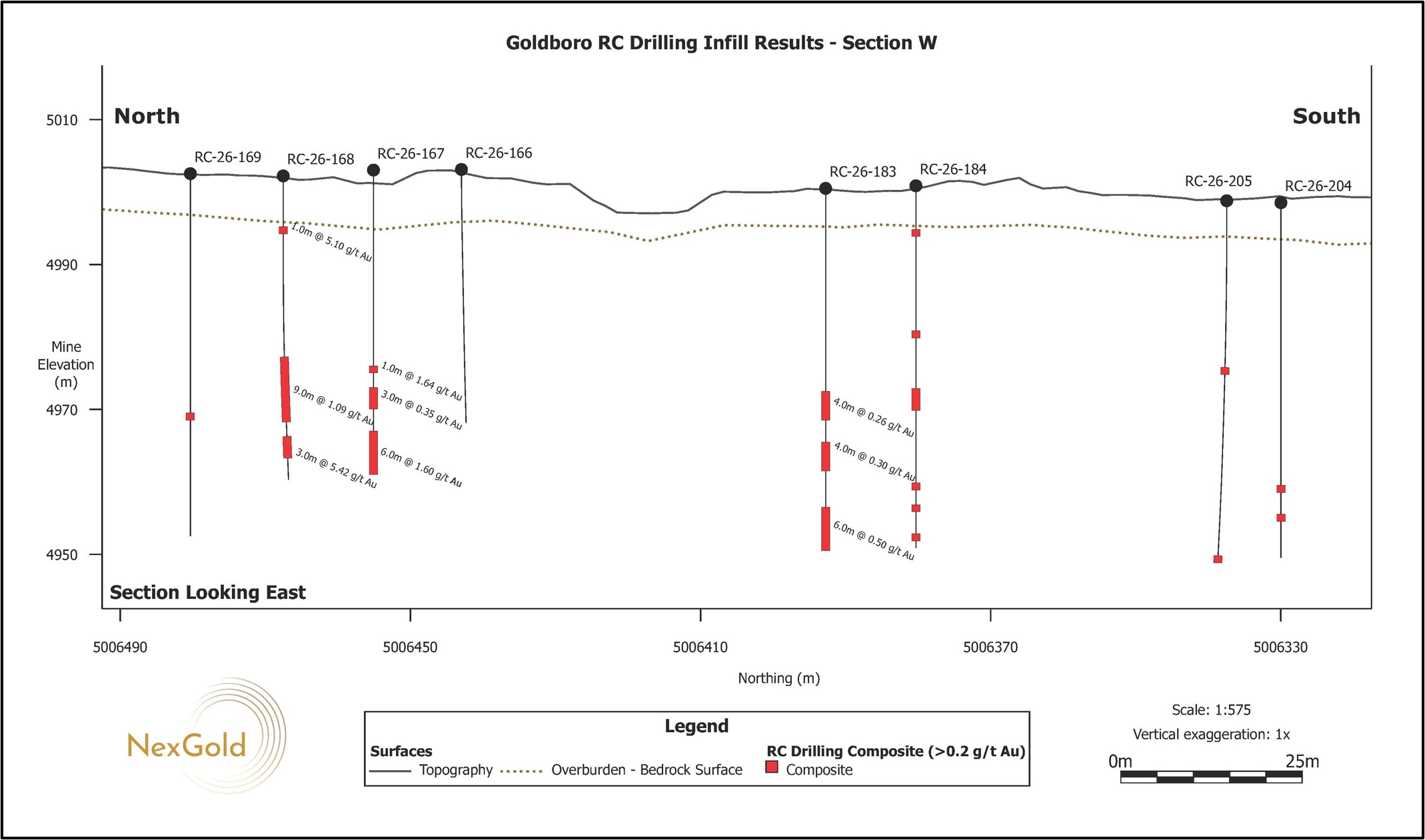
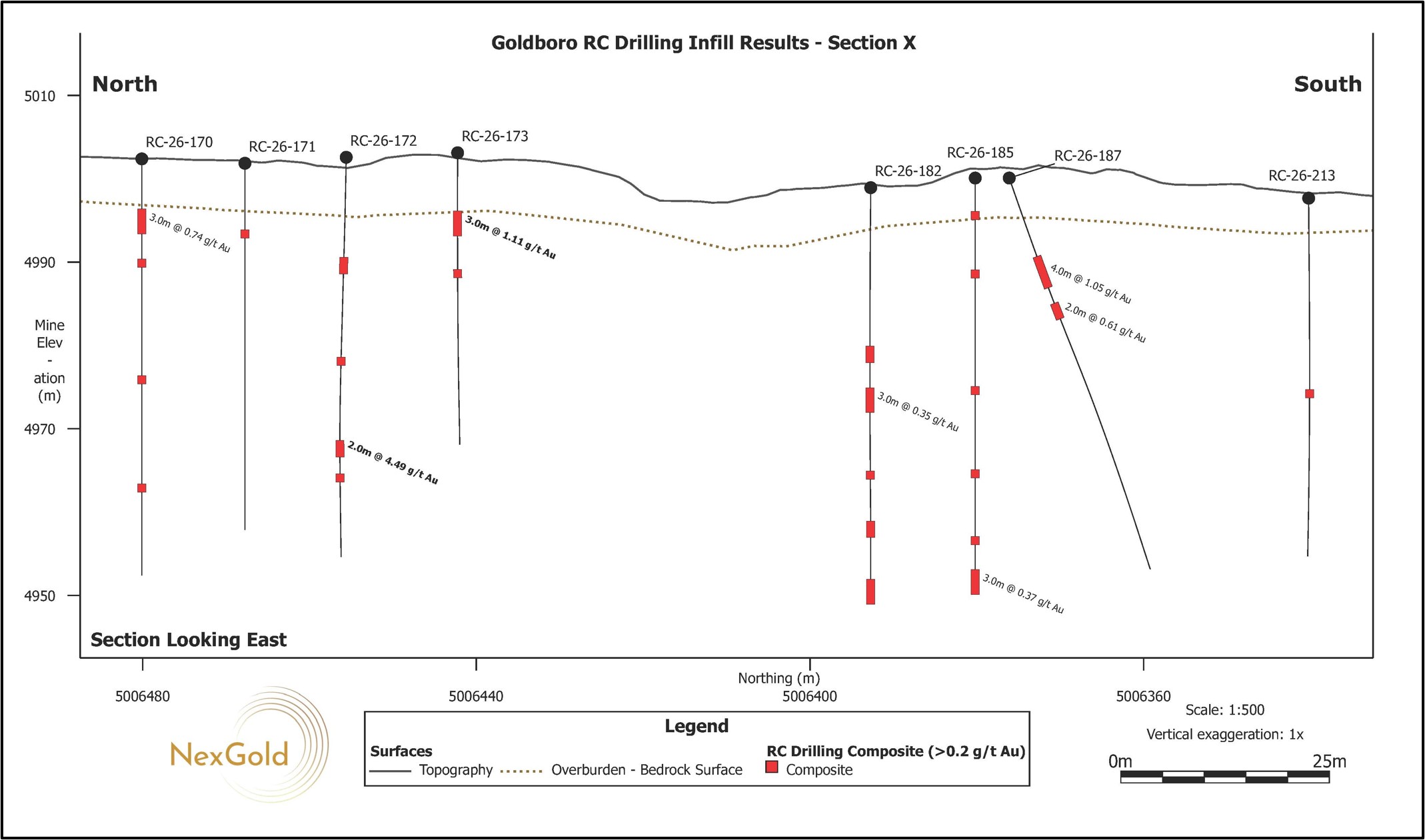
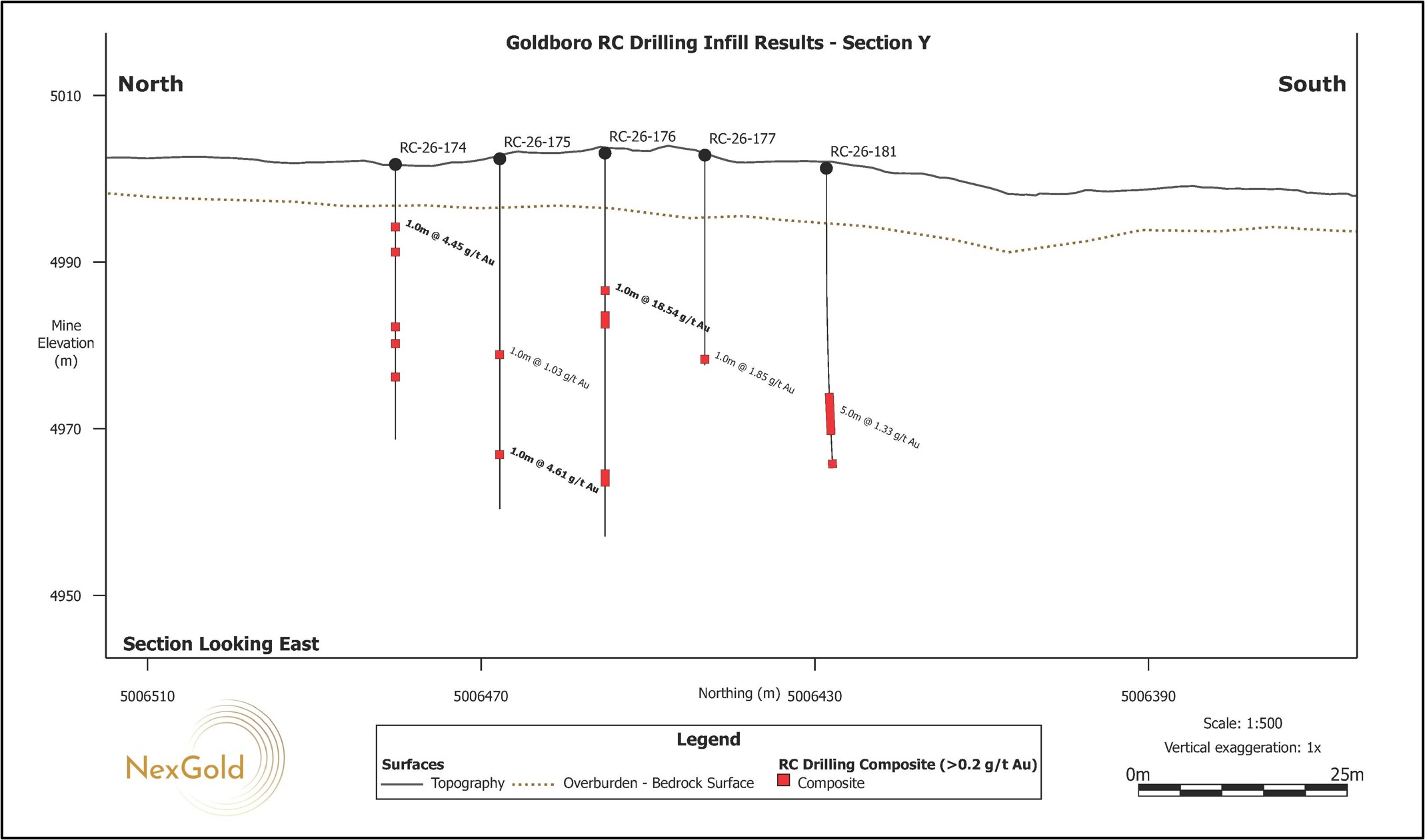
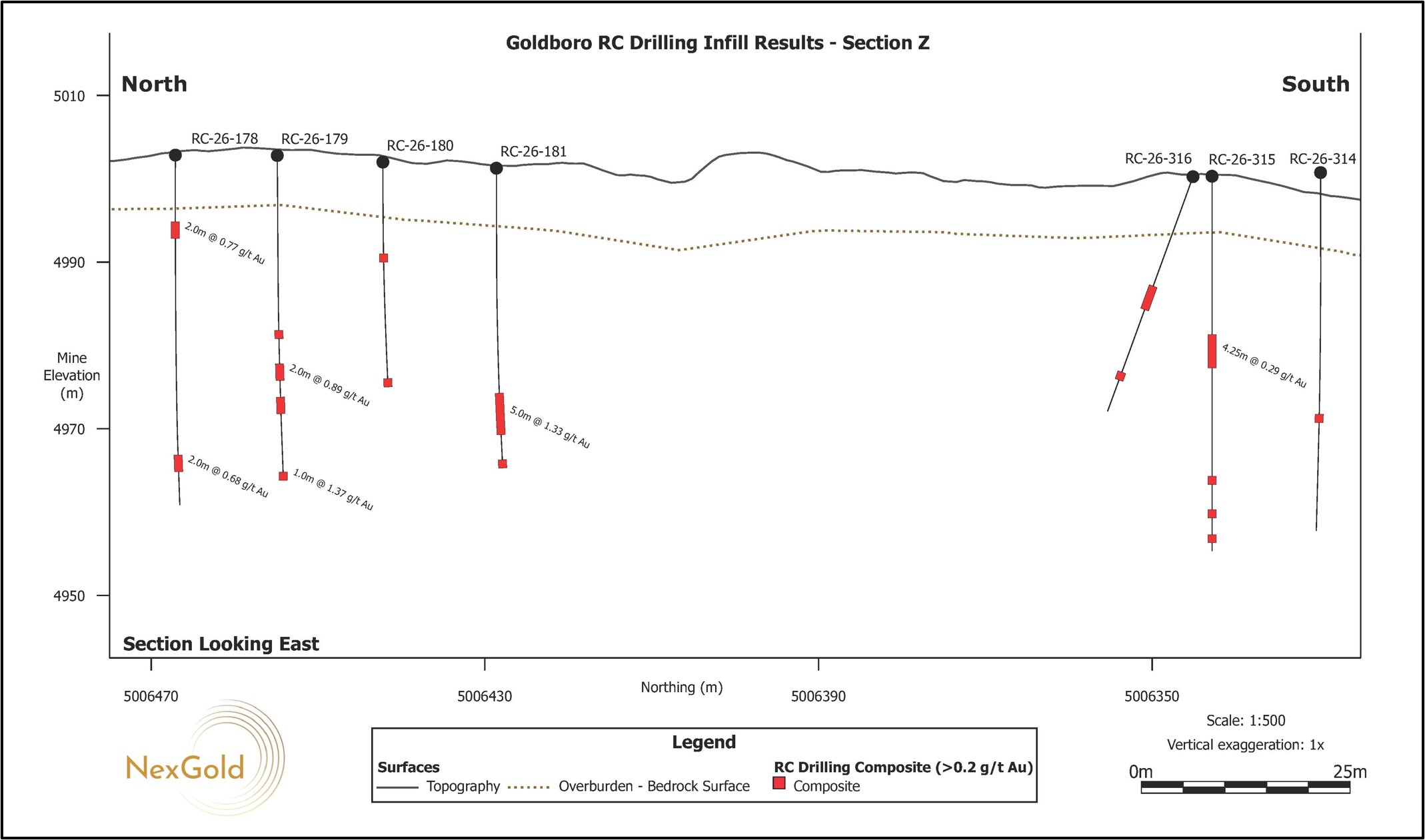
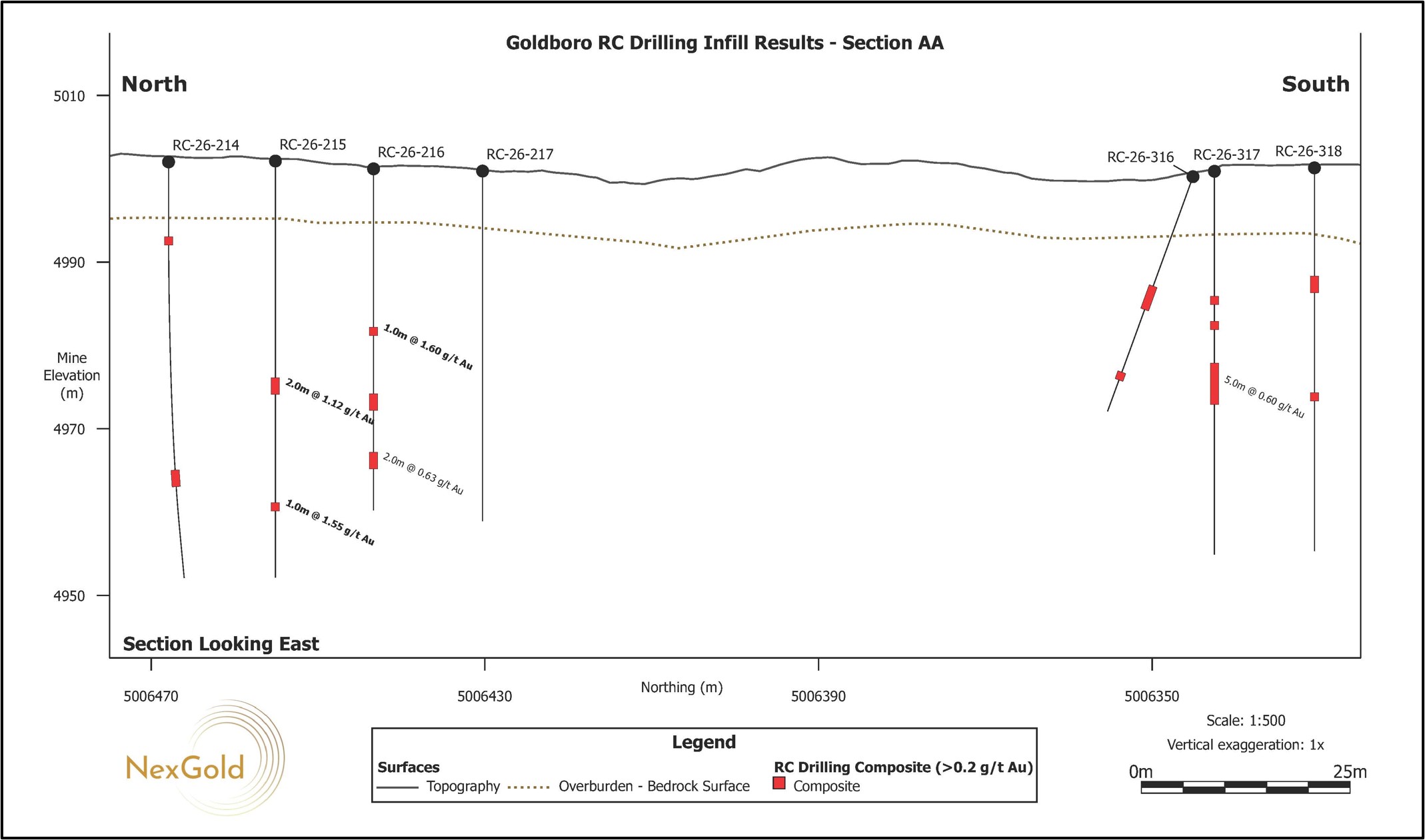
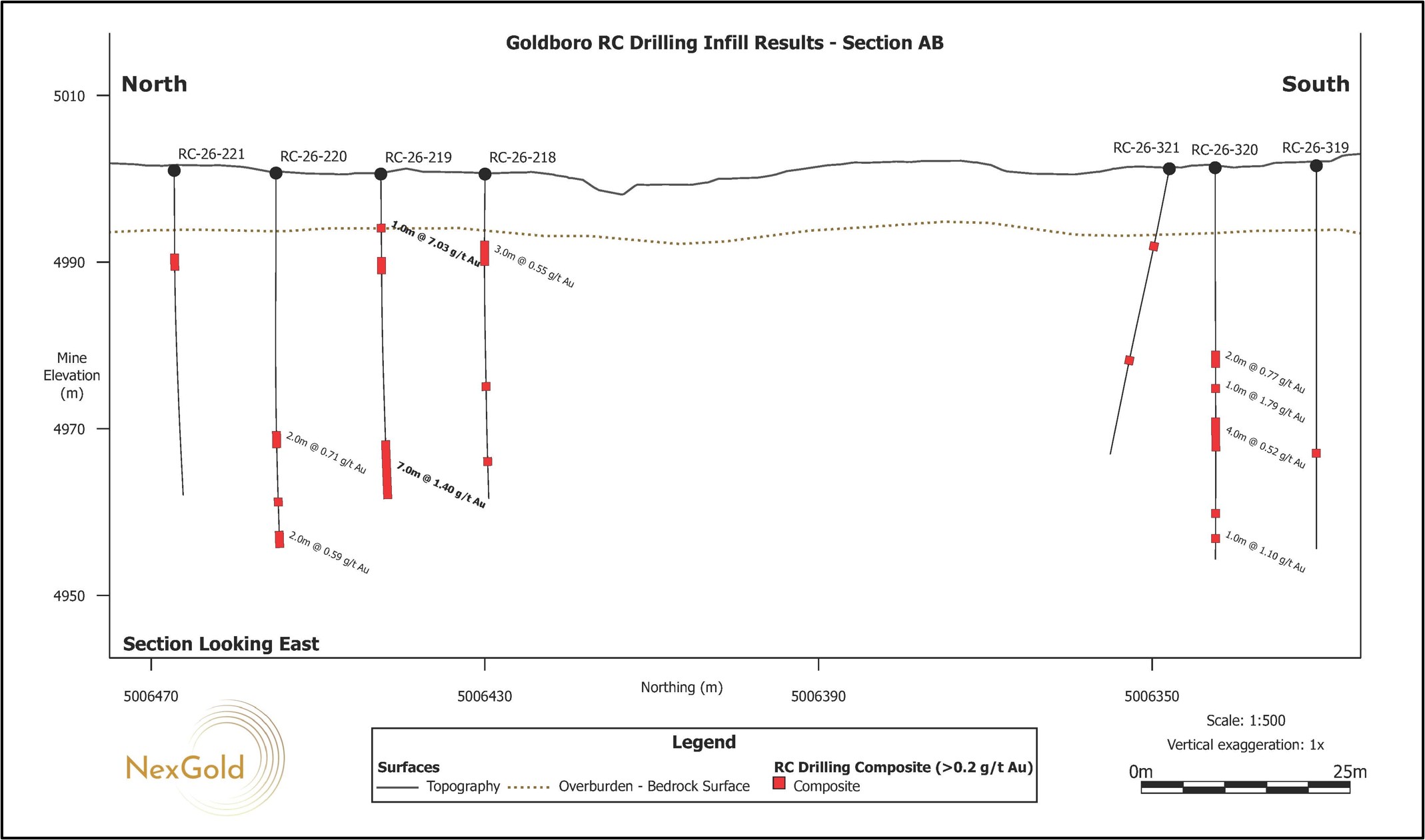
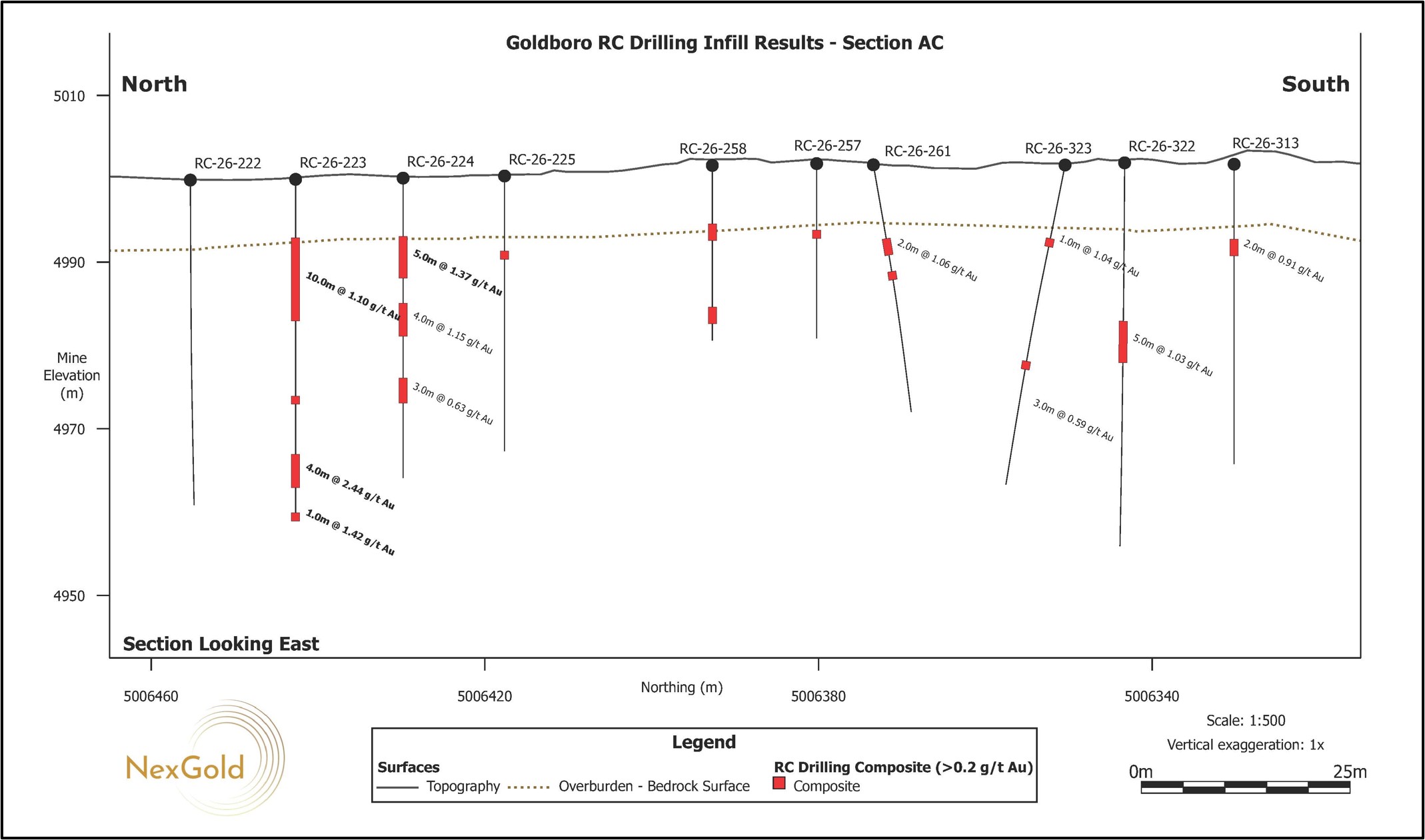
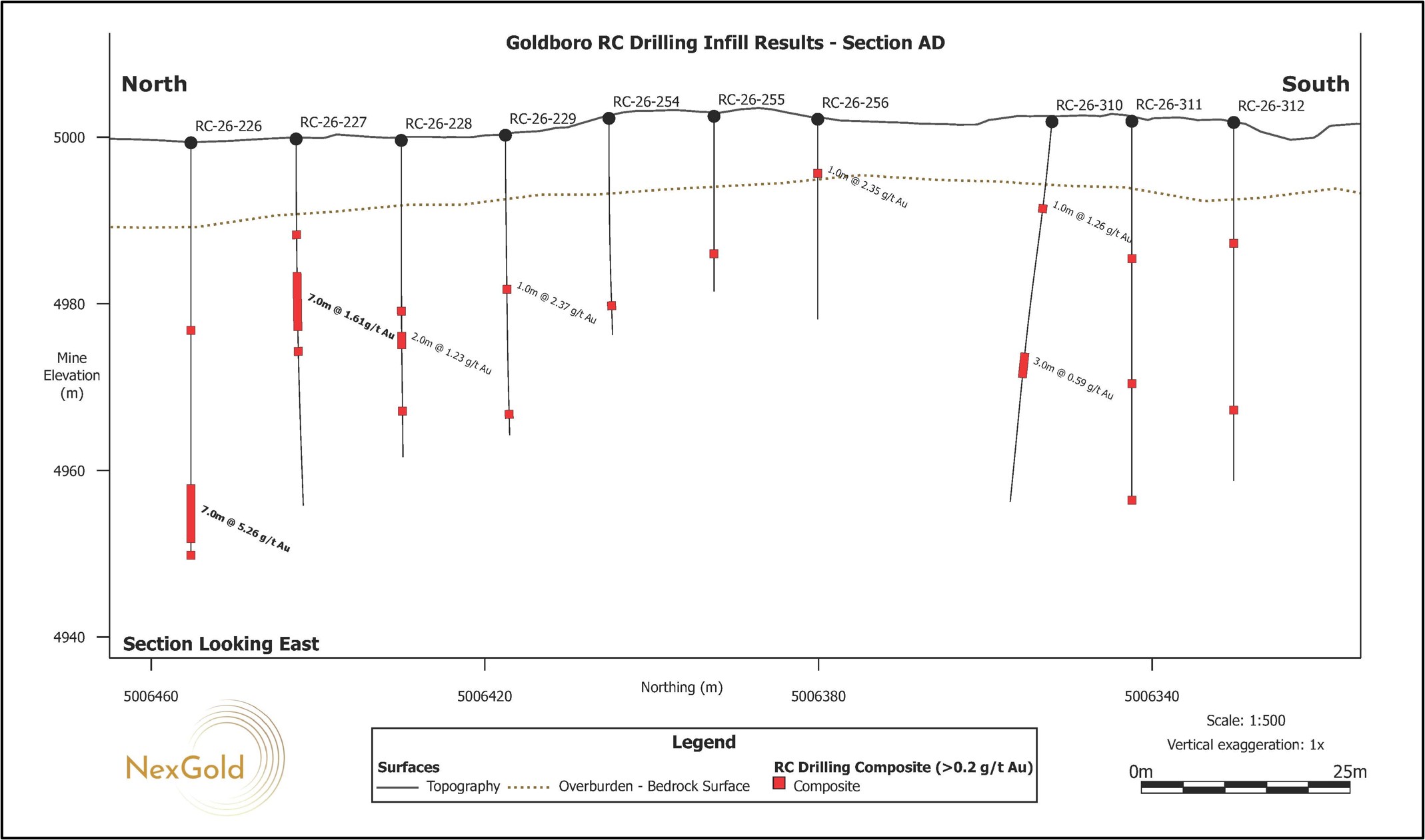
Table 1. RC Infill Drill Program collar information table for drill holes reported in this news release.
| Drill Hole ID1 | Easting (m)2 |
Northing (m)2 |
Mine Elevation (m) |
Azimuth (degrees) |
Inclination (degrees) |
Depth (m) |
| RC-26-160 | 606585.7 | 5006442.8 | 5004.2 | 0 | -90.0 | 21 |
| RC-26-161 | 606598.7 | 5006443.1 | 5003.8 | 0 | -90.0 | 37 |
| RC-26-162 | 606611.2 | 5006443.0 | 5003.2 | 0 | -90.0 | 10 |
| RC-26-163 | 606610.7 | 5006455.1 | 5003.3 | 0 | -90.0 | 50 |
| RC-26-164 | 606611.1 | 5006467.5 | 5003.6 | 0 | -90.0 | 50 |
| RC-26-165 | 606611.0 | 5006479.8 | 5003.9 | 0 | -90.0 | 50 |
| RC-26-166 | 606623.8 | 5006443.0 | 5003.1 | 0 | -90.0 | 35 |
| RC-26-167 | 606623.5 | 5006455.1 | 5003.0 | 0 | -90.0 | 42 |
| RC-26-168 | 606623.6 | 5006467.5 | 5002.2 | 0 | -90.0 | 42 |
| RC-26-169 | 606623.2 | 5006480.3 | 5002.6 | 0 | -90.0 | 50 |
| RC-26-170 | 606636.4 | 5006480.1 | 5002.4 | 0 | -90.0 | 50 |
| RC-26-171 | 606635.7 | 5006467.7 | 5001.9 | 0 | -90.0 | 44 |
| RC-26-172 | 606635.8 | 5006455.6 | 5002.6 | 0 | -90.0 | 48 |
| RC-26-173 | 606636.1 | 5006442.2 | 5003.1 | 0 | -90.0 | 35 |
| RC-26-174 | 606648.3 | 5006480.3 | 5001.7 | 0 | -90.0 | 33 |
| RC-26-175 | 606648.6 | 5006467.8 | 5002.4 | 0 | -90.0 | 42 |
| RC-26-176 | 606648.5 | 5006455.2 | 5003.1 | 0 | -90.0 | 46 |
| RC-26-177 | 606648.3 | 5006443.2 | 5002.8 | 0 | -90.0 | 25 |
| RC-26-178 | 606661.1 | 5006467.1 | 5002.9 | 0 | -90.0 | 42 |
| RC-26-179 | 606661.6 | 5006454.9 | 5002.8 | 0 | -90.0 | 39 |
| RC-26-180 | 606660.5 | 5006442.2 | 5002.0 | 0 | -90.0 | 27 |
| RC-26-181 | 606660.1 | 5006428.6 | 5001.3 | 0 | -90.0 | 36 |
| RC-26-182 | 606636.0 | 5006392.7 | 4998.9 | 0 | -90.0 | 50 |
| RC-26-183 | 606623.3 | 5006392.8 | 5000.5 | 0 | -90.0 | 50 |
| RC-26-184 | 606623.3 | 5006380.3 | 5000.9 | 0 | -90.0 | 50 |
| RC-26-185 | 606636.0 | 5006380.2 | 5000.1 | 0 | -90.0 | 50 |
| RC-26-186 | 606610.9 | 5006392.7 | 5001.3 | 0 | -90.0 | 50 |
| RC-26-187 | 606636.1 | 5006376.1 | 5000.1 | 180 | -70.0 | 50 |
| RC-26-188 | 606611.0 | 5006367.8 | 5001.0 | 0 | -90.0 | 50 |
| RC-26-189 | 606611.1 | 5006380.1 | 5001.1 | 0 | -90.0 | 50 |
| RC-26-190 | 606598.6 | 5006392.6 | 5001.6 | 0 | -90.0 | 50 |
| RC-26-191 | 606598.4 | 5006380.2 | 5002.8 | 0 | -90.0 | 50 |
| RC-26-192 | 606598.5 | 5006355.1 | 5002.9 | 0 | -90.0 | 50 |
| RC-26-193 | 606586.0 | 5006392.7 | 5002.7 | 0 | -90.0 | 50 |
| RC-26-194 | 606586.1 | 5006379.8 | 5003.8 | 0 | -90.0 | 50 |
| RC-26-195 | 606586.1 | 5006367.6 | 5003.8 | 0 | -90.0 | 50 |
| RC-26-196 | 606586.1 | 5006355.2 | 5003.3 | 0 | -90.0 | 50 |
| RC-26-199 | 606586.2 | 5006317.7 | 5001.4 | 0 | -90.0 | 50 |
| RC-26-200 | 606598.8 | 5006317.5 | 5001.0 | 0 | -90.0 | 50 |
| RC-26-201 | 606611.1 | 5006317.7 | 5000.6 | 0 | -90.0 | 50 |
| RC-26-202 | 606598.8 | 5006330.1 | 5001.3 | 0 | -90.0 | 50 |
| RC-26-203 | 606611.2 | 5006330.2 | 5000.8 | 0 | -90.0 | 50 |
| RC-26-204 | 606623.6 | 5006330.0 | 4998.5 | 0 | -90.0 | 49 |
| RC-26-205 | 606623.0 | 5006337.5 | 4998.8 | 0 | -90.0 | 50 |
| RC-26-209 | 606586.0 | 5006326.2 | 5001.5 | 0 | -75.0 | 50 |
| RC-26-210 | 606586.0 | 5006326.1 | 5001.5 | 0 | -90.0 | 50 |
| RC-26-211 | 606598.8 | 5006330.1 | 5001.3 | 0 | -75.0 | 50 |
| RC-26-212 | 606610.8 | 5006333.4 | 5000.5 | 0 | -70.0 | 50 |
| RC-26-213 | 606636.5 | 5006340.2 | 4997.7 | 0 | -90.0 | 43 |
| RC-26-214 | 606673.5 | 5006467.9 | 5002.0 | 0 | -90.0 | 50 |
| RC-26-215 | 606673.3 | 5006455.1 | 5002.1 | 0 | -90.0 | 50 |
| RC-26-216 | 606673.5 | 5006443.3 | 5001.2 | 0 | -90.0 | 41 |
| RC-26-217 | 606673.5 | 5006430.3 | 5000.9 | 0 | -90.0 | 42 |
| RC-26-218 | 606686.3 | 5006430.0 | 5000.6 | 0 | -90.0 | 39 |
| RC-26-219 | 606686.3 | 5006442.5 | 5000.6 | 0 | -90.0 | 39 |
| RC-26-220 | 606685.9 | 5006455.0 | 5000.7 | 0 | -90.0 | 45 |
| RC-26-221 | 606685.7 | 5006467.2 | 5001.0 | 0 | -90.0 | 39 |
| RC-26-222 | 606698.7 | 5006455.3 | 4999.9 | 0 | -90.0 | 39 |
| RC-26-223 | 606698.6 | 5006442.7 | 4999.9 | 0 | -90.0 | 41 |
| RC-26-224 | 606698.2 | 5006429.8 | 5000.1 | 0 | -90.0 | 36 |
| RC-26-225 | 606698.6 | 5006417.6 | 5000.3 | 0 | -90.0 | 33 |
| RC-26-226 | 606711.4 | 5006455.2 | 4999.3 | 0 | -90.0 | 50 |
| RC-26-227 | 606711.0 | 5006442.6 | 4999.8 | 0 | -90.0 | 44 |
| RC-26-228 | 606710.8 | 5006430.0 | 4999.6 | 0 | -90.0 | 38 |
| RC-26-229 | 606710.9 | 5006417.5 | 5000.2 | 0 | -90.0 | 36 |
| RC-26-254 | 606711.1 | 5006405.1 | 5002.3 | 0 | -90.0 | 25 |
| RC-26-255 | 606711.0 | 5006392.5 | 5002.5 | 0 | -90.0 | 20 |
| RC-26-256 | 606711.0 | 5006380.1 | 5002.1 | 0 | -90.0 | 24 |
| RC-26-257 | 606698.4 | 5006380.2 | 5001.8 | 0 | -90.0 | 20 |
| RC-26-258 | 606698.3 | 5006392.7 | 5001.6 | 0 | -90.0 | 21 |
| RC-26-261 | 606698.7 | 5006373.4 | 5001.7 | 0 | -80.0 | 30 |
| RC-26-310 | 606711.5 | 5006352.0 | 5001.9 | 0 | -85.0 | 46 |
| RC-26-311 | 606710.7 | 5006342.4 | 5001.9 | 180 | -90.0 | 46 |
| RC-26-312 | 606711.0 | 5006330.2 | 5001.8 | 0 | -90.0 | 43 |
| RC-26-313 | 606698.6 | 5006330.2 | 5001.8 | 0 | -90.0 | 36 |
| RC-26-314 | 606666.9 | 5006329.8 | 5000.8 | 0 | -90.0 | 43 |
| RC-26-315 | 606660.7 | 5006342.8 | 5000.3 | 0 | -90.0 | 45 |
| RC-26-316 | 606662.9 | 5006345.1 | 5000.3 | 0 | -70.0 | 30 |
| RC-26-317 | 606673.3 | 5006342.5 | 5000.9 | 180 | -90.0 | 46 |
| RC-26-318 | 606673.7 | 5006330.5 | 5001.3 | 180 | -90.0 | 46 |
| RC-26-319 | 606685.8 | 5006330.3 | 5001.6 | 180 | -90.0 | 46 |
| RC-26-320 | 606685.7 | 5006342.4 | 5001.3 | 180 | -90.0 | 46 |
| RC-26-321 | 606686.1 | 5006347.9 | 5001.2 | 0 | -80.0 | 35 |
| RC-26-322 | 606698.3 | 5006343.3 | 5001.9 | 0 | -90.0 | 46 |
| RC-26-323 | 606698.4 | 5006350.4 | 5001.7 | 0 | -80.0 | 39 |
1. Drill Holes RC-26-002 to 152, -197, -206 to 207 were presented in news releases dated June 25, 2026 and July 7, 2026. Assays are pending for all remaining drill holes not listed here and will be reported in future news releases.
2. Collar coordinates are Universal Transverse Mercator, North American Datum 1983.
Table 2. Significant drill assay highlights from the RC Infill Drill Program.
| Drill Hole ID3 | From (m) | To (m) | Interval (m)4 | Au (g/t) |
| RC-26-161 | 25.0 | 27.0 | 2.0 | 0.93 |
| and | 30.0 | 36.0 | 6.0 | 0.95 |
| RC-26-163 | 25.0 | 36.0 | 11.0 | 0.90 |
| and | 38.0 | 40.0 | 2.0 | 14.97 |
| including | 39.0 | 40.0 | 1.0 | 29.62 |
| RC-26-164 | 24.0 | 26.0 | 2.0 | 0.76 |
| and | 43.0 | 44.0 | 1.0 | 1.34 |
| RC-26-165 | 24.0 | 25.0 | 1.0 | 1.01 |
| RC-26-167 | 27.0 | 28.0 | 1.0 | 1.64 |
| and | 30.0 | 33.0 | 3.0 | 0.35 |
| and | 36.0 | 42.0 | 6.0 | 1.60 |
| RC-26-168 | 7.0 | 8.0 | 1.0 | 5.10 |
| and | 25.0 | 34.0 | 9.0 | 1.09 |
| and | 36.0 | 39.0 | 3.0 | 5.42 |
| including | 36.0 | 37.0 | 1.0 | 15.69 |
| RC-26-170 | 6.0 | 9.0 | 3.0 | 0.74 |
| RC-26-172 | 34.0 | 36.0 | 2.0 | 4.49 |
| including | 35.0 | 36.0 | 1.0 | 8.72 |
| RC-26-173 | 7.0 | 10.0 | 3.0 | 1.11 |
| RC-26-174 | 7.0 | 8.0 | 1.0 | 4.45 |
| RC-26-175 | 23.0 | 24.0 | 1.0 | 1.03 |
| and | 35.0 | 36.0 | 1.0 | 4.61 |
| RC-26-176 | 16.0 | 17.0 | 1.0 | 18.54 |
| RC-26-177 | 24.0 | 25.0 | 1.0 | 1.85 |
| RC-26-178 | 8.0 | 10.0 | 2.0 | 0.77 |
| and | 36.0 | 38.0 | 2.0 | 0.68 |
| RC-26-179 | 25.0 | 27.0 | 2.0 | 0.89 |
| and | 38.0 | 39.0 | 1.0 | 1.37 |
| RC-26-181 | 27.0 | 32.0 | 5.0 | 1.33 |
| RC-26-182 | 24.0 | 27.0 | 3.0 | 0.35 |
| RC-26-183 | 28.0 | 32.0 | 4.0 | 0.26 |
| and | 35.0 | 39.0 | 4.0 | 0.30 |
| and | 44.0 | 50.0 | 6.0 | 0.50 |
| RC-26-185 | 47.0 | 50.0 | 3.0 | 0.37 |
| RC-26-186 | 42.0 | 47.0 | 5.0 | 0.30 |
| RC-26-187 | 10.0 | 14.0 | 4.0 | 1.05 |
| and | 16.0 | 18.0 | 2.0 | 0.61 |
| RC-26-189 | 33.0 | 36.0 | 3.0 | 0.55 |
| and | 44.0 | 48.0 | 4.0 | 0.94 |
| RC-26-190 | 29.0 | 34.0 | 5.0 | 0.42 |
| and | 41.0 | 45.0 | 4.0 | 0.91 |
| RC-26-192 | 36.0 | 41.0 | 5.0 | 1.19 |
| RC-26-193 | 15.0 | 22.0 | 7.0 | 0.89 |
| and | 27.0 | 34.0 | 7.0 | 0.52 |
| and | 36.0 | 44.0 | 8.0 | 0.74 |
| RC-26-194 | 31.0 | 36.0 | 5.0 | 0.36 |
| RC-26-195 | 9.0 | 14.0 | 5.0 | 7.08 |
| including | 9.0 | 10.0 | 1.0 | 25.11 |
| RC-26-196 | 35.0 | 39.0 | 4.0 | 1.84 |
| RC-26-202 | 39.0 | 40.0 | 1.0 | 1.05 |
| RC-26-212 | 49.0 | 50.0 | 1.0 | 5.20 |
| RC-26-215 | 26.0 | 28.0 | 2.0 | 1.12 |
| and | 41.0 | 42.0 | 1.0 | 1.55 |
| RC-26-216 | 19.0 | 20.0 | 1.0 | 1.60 |
| and | 34.0 | 36.0 | 2.0 | 0.63 |
| RC-26-218 | 8.0 | 11.0 | 3.0 | 0.55 |
| RC-26-219 | 6.0 | 7.0 | 1.0 | 7.03 |
| and | 32.0 | 39.0 | 7.0 | 1.40 |
| RC-26-220 | 31.0 | 33.0 | 2.0 | 0.71 |
| and | 43.0 | 45.0 | 2.0 | 0.59 |
| RC-26-223 | 7.0 | 17.0 | 10.0 | 1.10 |
| and | 33.0 | 37.0 | 4.0 | 2.44 |
| and | 40.0 | 41.0 | 1.0 | 1.42 |
| RC-26-224 | 7.0 | 12.0 | 5.0 | 1.37 |
| and | 15.0 | 19.0 | 4.0 | 1.15 |
| and | 24.0 | 27.0 | 3.0 | 0.63 |
| RC-26-226 | 41.0 | 48.0 | 7.0 | 5.26 |
| including | 44.0 | 45.0 | 1.0 | 31.29 |
| RC-26-227 | 16.0 | 23.0 | 7.0 | 1.61 |
| RC-26-228 | 23.0 | 25.0 | 2.0 | 1.23 |
| RC-26-229 | 18.0 | 19.0 | 1.0 | 2.37 |
| RC-26-256 | 6.0 | 7.0 | 1.0 | 2.35 |
| RC-26-261 | 9.0 | 11.0 | 2.0 | 1.06 |
| RC-26-310 | 10.0 | 11.0 | 1.0 | 1.26 |
| and | 28.0 | 31.0 | 3.0 | 0.59 |
| RC-26-313 | 9.0 | 11.0 | 2.0 | 0.91 |
| RC-26-317 | 23.0 | 28.0 | 5.0 | 0.60 |
| RC-26-320 | 22.0 | 24.0 | 2.0 | 0.77 |
| and | 26.0 | 27.0 | 1.0 | 1.79 |
| and | 30.0 | 34.0 | 4.0 | 0.52 |
| and | 44.0 | 45.0 | 1.0 | 1.10 |
| RC-26-322 | 19.0 | 24.0 | 5.0 | 1.03 |
| RC-26-323 | 9.0 | 10.0 | 1.0 | 1.04 |
3. Drill Holes between RC-26-160, 162, 166, 169, 171, 180, 184, 188, 191, 199, 200-201, 202-211, 213-214, 217, 221-222, 225, 254, 257-258, 311-312, 314-316, 318-319, and 321 not listed in Table 2 do not have significant assays.
4. True width of mineralization varies between 50 and 100% depending on the location of the drillhole and orientation of the mineralized zone.
QA/QC
The Company has implemented a quality assurance and quality control (“QA/QC”) program to ensure that sampling and analytical procedures for exploration work are conducted in accordance with CIM Exploration Best Practice Guidelines. The program includes the regular insertion of certified reference materials, blanks, and laboratory prepared sample duplicates into the sample analysis stream. Laboratory QA/QC procedures also include internal standards, blanks, and repeat analyses. QA/QC results are reviewed on an ongoing basis by the Company’s technical team, and any failures or anomalous results are investigated, with re-analysis requested where appropriate.
Reverse circulation drill samples were collected at nominal one-metre intervals using a cyclone and riffle/rotary splitter system. All RC samples were weighed and sample weight variability and recovery checked throughout the drill program to ensure sample quality. A 2.5 kg sample weight was targeted throughout the program with an average recovery of ~85%. A geologist is always present at the rig to monitor drilling and sampling procedures. Representative split samples were placed in labelled sample bags, sealed, and transported under chain-of-custody procedures to ALS Canada Ltd. (“ALS”) in Moncton, New Brunswick. ALS is independent of the Company. Samples submitted for gold analysis by PhotonAssay™ were crushed to approximately 70% passing 2 mm, after which a representative 500 g split was collected using a riffle splitter and transferred into jars for analysis at ALS in Thunder Bay, Ontario.
PhotonAssay™ uses high-energy X-rays to determine gold content from a large sample aliquot, typically 500 g of crushed material. The method is non-destructive and is particularly suited to gold systems where larger sample aliquots may improve representativity. For samples returning greater than 350 g/t Gold, an additional PhotonAssay™ analysis is completed using higher-grade standards. Due to the non-destructive nature of the PhotonAssay™ analysis, standard 30 g fire assay check analyses are conducted routinely on the jarred material to compare results with the PhotonAssay™ data and monitor analytical performance.
Selected samples analyzed via PhotonAssay™ will be re-analyzed via total pulp metallics. For the total pulp metallics analysis, the entire sample is crushed to -10mesh and pulverized to 95% -150mesh. The total sample is then weighed and screened to 150mesh. The +150mesh fraction is fire assayed for Au, and a 30 g subsample of the -150mesh fraction analyzed via fire assay. A weighted average gold grade is calculated for the final reportable gold grade. Total pulp metallics assays for drill holes sited within this press release may be updated in a future news release.
Qualified Person
Paul McNeill, P.Geo., VP Exploration of NexGold, is a “Qualified Person” as defined under National Instrument 43-101 – Standards of Disclosure for Mineral Projects and has reviewed the available data, composites and QA/QC information related to the drill program and has approved the scientific and technical disclosure contained in this news release on behalf of NexGold.
About NexGold Mining Corp.
NexGold is a gold-focused company with assets in Canada and Alaska, including the Goldboro Gold Project in Nova Scotia, the Goliath Gold Complex (which includes the Goliath, Goldlund and Miller deposits) in Northwestern Ontario, and additional exploration projects across Canada. NexGold also holds a 100% interest in the high-grade Niblack copper-gold-zinc-silver VMS project in southeast Alaska. NexGold is committed to ongoing, meaningful engagement with regional communities and Indigenous Nations to support sustainable development, safe operations, and shared economic and social benefits.
Further details about NexGold, including a Feasibility Study for the Goldboro Gold Project and a Prefeasibility Study for the Goliath Gold Complex, are available under the Company’s issuer profile on www.sedarplus.ca and on NexGold’s website at www.nexgold.com.
Contact:
| Kevin Bullock President and CEO, Director +1 (416) 408-3703 kbullock@nexgold.com |
Investor Relations +1 (647) 547-5357 gditomaso@nexgold.com |
Cautionary Note Regarding Forward-Looking Information
This news release contains or incorporates by reference “forward-looking information” within the meaning of applicable Canadian securities legislation and “forward-looking statements” within the meaning of applicable U.S. securities laws (collectively, “forward-looking information”). Except for statements of historical fact, this news release contains forward-looking information including, without limitation: information regarding the Company’s strategic objectives and plans; the timing, advancement and results of the RC Infill Drill Program; the potential reclassification of portions of Mineral Resources from the Indicated category to the Measured category; the incorporation of RC Infill Drill Program results into a future Mineral Resource Estimate; the completion and timing of the updated Feasibility Study; the timing of a potential investment decision; and the potential development and construction of the Goldboro Gold Project;. Generally, forward-looking information is characterized by the use of forward-looking terminology such as “plans”, “expects” or “does not expect”, “is expected”, “budget”, “scheduled”, “estimates”, “forecasts”, “intends”, “is projected”, “anticipates” or “does not anticipate”, “believes”, “targets”, or variations of such words and phrases. Forward-looking information may also be identified in statements where certain actions, events or results “may”, “could”, “should”, “would”, “might”, “will be taken”, “occur” or “be achieved”.
Forward-looking information involves known or unknown risks, uncertainties and other factors, which may cause the actual results, performance or achievements of the Company to be materially different from those projected by such forward-looking statements. Such factors include, among others: that financing will be available; the plan for, and actual results of, current exploration activities; expectations relating to future exploration, development and production activities as well as growth potential for NexGold’s operations; risks relating to the ability of exploration activities (including drill results) to accurately predict mineralization; reliance on third-parties, including governmental entities, for mining activities; the ability of NexGold to complete further exploration activities, including drilling at the Goliath Gold Complex and Goldboro deposits; the ability of the Company to obtain required approvals; the results of exploration activities; risks relating to mining activities; delays or changes in plans with respect to exploration or development projects or capital expenditures; the uncertainty of mineral resources, production and cost estimates; health, safety and environmental risks; worldwide demand for gold and base metals; gold price and other commodity price and exchange rate fluctuations; environmental risks; competition; incorrect assessment of the value of acquisitions; ability to access sufficient capital from internal and external sources; changes in legislation, including but not limited to tax laws, royalties and environmental regulations; and those factors described in the Management’s Discussion and Analysis for the year ended December 31, 2025 of the Company and in the Company’s most recent disclosure documents filed under its SEDAR+ profile at www.sedarplus.ca. Although management of the Company has attempted to identify important factors that could cause actual actions, events or results to differ materially from those described in forward-looking information, there may be other factors that cause actions, events or results not to be anticipated, estimated or intended. There can be no assurance that forward-looking information will prove to be accurate, as actual results and future events could differ materially from those anticipated in such information. Accordingly, readers are cautioned not to place undue reliance on forward-looking information. The forward-looking information contained herein is presented to assist shareholders in understanding the Company’s the Company’s plans and objectives and may not be appropriate for other purposes. The Company does not undertake to update any forward-looking information contained herein, except in accordance with applicable securities laws.
Neither TSX Venture Exchange nor its Regulation Services Provider (as that term is defined in the policies of the TSX Venture Exchange) accepts responsibility for the adequacy or accuracy of this news release. No stock exchange, securities commission or other regulatory authority has approved or disapproved the information contained herein.
